


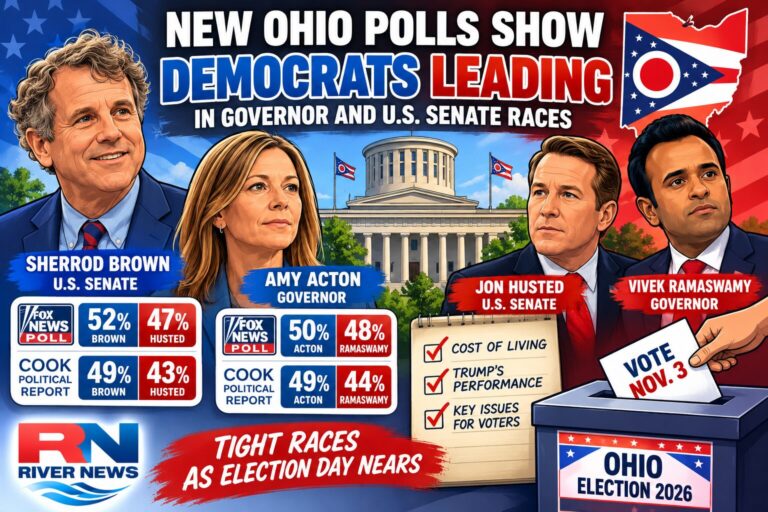
COLUMBUS, Ohio — Two new polls show Democratic candidates Amy Acton and Sherrod Brown leading their Republican opponents in Ohio’s races for governor and U.S. Senate ahead of the November 3 election.
According to polling results reported by NBC4, both the Fox News poll and a Cook Political Report survey found Democrats holding leads, although the margins vary between the two surveys.
In the U.S. Senate race, former Senator Sherrod Brown leads Republican incumbent Jon Husted 52% to 47% among likely voters in the Fox News poll. The Cook Political Report survey shows Brown ahead 49% to 43%.
The governor’s race appears closer. Fox News found Acton leading Republican Vivek Ramaswamy 50% to 48%, while Cook’s survey placed Acton ahead 49% to 44%.
The Fox News poll surveyed 2,005 registered Ohio voters between October 15 and October 19, including 1,592 likely voters. The likely-voter results have a margin of sampling error of plus or minus two percentage points. Cook’s survey included 959 likely voters interviewed October 9 through October 13.
Economic concerns remain a significant issue for voters. In the Fox News survey, 46% of likely voters said their family’s financial situation had worsened over the past two years, compared with 19% who reported improvement.
The polling also revealed differences between male and female voters. Women favored Brown by 14 percentage points and Acton by 10 points, while men leaned toward Husted and Ramaswamy.
President Donald Trump received a 43% approval rating among likely voters in the Fox News poll, with 57% disapproving of his job performance.
Ohio’s Senate race has also attracted substantial political spending. According to advertising analytics company AdImpact, approximately $422.6 million has been spent or reserved for advertising in the contest.
Both surveys were conducted before the release of Ramaswamy’s controversial campaign advertisement featuring Acton’s estranged mother, meaning the polling does not reflect any potential impact from that controversy.
While the results suggest competitive races with Democratic leads, the polls represent voter preferences at the time they were conducted and do not predict the final election outcome.
Ohio voters will decide both races on Tuesday, November 3.
Source: NBC4 WCMH-TV — Thomas Cobb, “Two Ohio polls put Amy Acton, Sherrod Brown ahead in Ohio’s Senate, governor’s races,” published October 23, 2026. Polling data from Fox News and the Cook Political Report.