







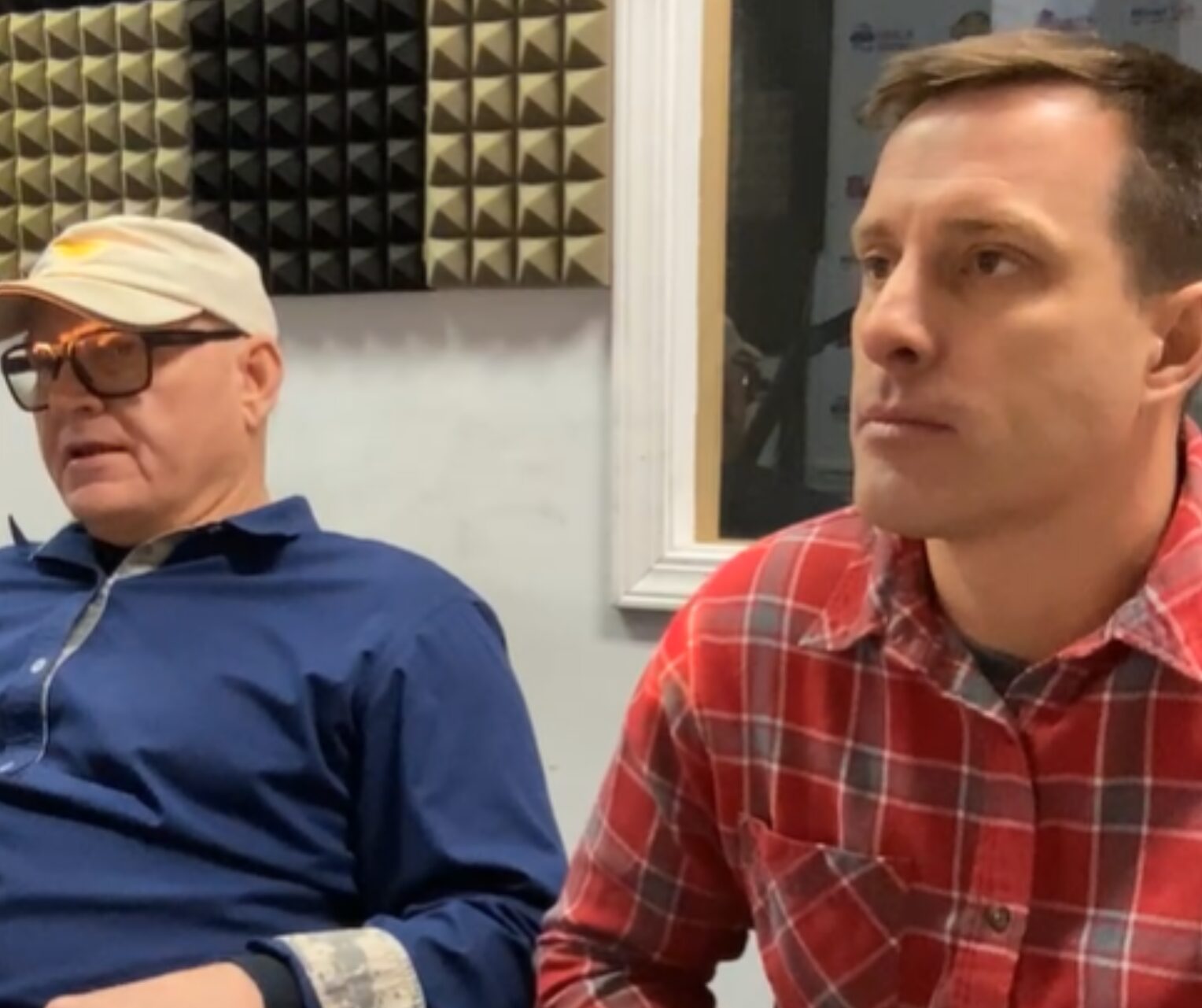
BELMONT COUNTY, Ohio – Local voters heard a heated debate between former State Senator Frank Hoagland and incumbent State Representative Ron Ferguson broadcast live on Dimitri! Live and Dangerously Local, produced by RiverNews.org on Tuesday morning.
Both candidates are vying for the Republican nomination for the Ohio House of Representatives in the 96th District — the seat that represents all of Jefferson and Monroe counties and a portion of Belmont County in the Ohio state legislature.
Both men sparred back and forth with Ferguson questioning why Hoagland resigned from the Ohio Senate in 2023 and Hoagland claiming that Ferguson was absent from making votes in Columbus.
Listen to the debate here:
SEGMENT 1
SEGMENT 2
SEGMENT 3
SEGMENT 4
SEGMENT 5
SEGMENT 6
The candidates debated many issues outlined below including the Ohio gas tax, infrastructure, Somali immigrants and tax money not being used to help Eastern Ohio.
Blaine Bridge Project
Ferguson said he was instrumental in getting the Blaine Hill Bridge project accelerated.
“Getting the Blaine Hill Bridge open early. I was the only elected official that went down and met with the Blaine Hill Bridge Committee. Frank likes to say that I don’t have good relationships. I clearly do with ODOT because they moved the project up by two years. It’s going to open up in the spring,” ferguson said.
Ferguson used this as an example of his local engagement and his ability to work with the Ohio Department of Transportation (ODOT), contrasting it with Hoagland’s claims that Ferguson doesn’t maintain good relationships with state officials. He mentioned this as part of his broader argument about “showing up” and doing the real work in the district rather than just being present for votes in Columbus.
Gas Tax Vote Becomes Central Flashpoint
One of the most heated moments of the debate focused on Ohio’s gas tax increase, which raised the cost of fuel by 10.5 cents per gallon.
Hoagland defended his vote in favor of the increase, arguing it was necessary to fund infrastructure and ensure public safety.
“In order for our infrastructure to be intact and have the mobility, get our kids to and from school every day, that is what we need to do,” Hoagland said.
He cited deteriorating roads in Ohio’s hilly terrain as a safety concern for drivers, first responders, and school transportation.
Ferguson sharply criticized the vote, saying infrastructure funding should come from cutting other spending rather than raising taxes.
“He thinks taking more money out of the people listening to this program… is the way to do it. My way to do it is to stand up,” Ferguson said.
Ferguson pointed to state funding commitments, including a $2 billion Intel investment and $600 million for a Cleveland Browns stadium project, as examples of spending that could be reduced instead.
Intel Investment Divides Candidates
The candidates also clashed over Ohio’s investment in Intel Corporation in Licking County.
Hoagland supported the package, framing it as a national security issue tied to domestic microchip production.
“The Department of Defense wanted to ensure microchips for military equipment didn’t contain malware,” Hoagland said.
Ferguson opposed the measure, arguing Eastern Ohio taxpayers should not subsidize development in other regions of the state.
“That’s not what our tax dollars are meant for, and I voted no,” Ferguson said.
Attendance and Commitment Questioned
Ferguson repeatedly criticized Hoagland for leaving office before completing his Senate term, calling him a “quitter.”
“Finish what you start,” Ferguson said, citing the commitment made to voters.
Hoagland responded that he left office with 16 session days remaining to work on counterterrorism initiatives with the Ohio Department of Public Safety.
Hoagland then accused Ferguson of missing 175 votes during his tenure. Ferguson countered that he had only six excused absences in six years and said many of the cited votes were procedural.
Spending on Somali Communities Sparks Controversy
Ferguson accused Hoagland of voting to allocate more than $1 million to Somali communities through House Bill 33, Ohio’s state budget.
Hoagland disputed the characterization but acknowledged he was not present for the full session after leaving office early.
Relationship With State Leadership
Hoagland claimed Columbus lawmakers encouraged him to challenge Ferguson, saying Republican leadership was frustrated with the incumbent.
Ferguson rejected that claim, saying opposition from party leadership stems from his resistance to sending Eastern Ohio money to other parts of the state.
Legislative Accomplishments
Ferguson highlighted legislation on hospital price transparency, ending Ohio’s COVID-19 state of emergency, and laws addressing women’s sports and medical procedures for minors.
Hoagland cited his work on legislation for Transcranial Magnetic Stimulation (TMS) — a non‑invasive, drug‑free brain stimulation therapy that many VA medical centers and veteran programs offer for certain mental health conditions. Hoagland said he is traveling to President Trump’s Mar-a-Lago resort to discuss this treatment for veterans.
Second Amendment Positions
Both candidates emphasized support for Second Amendment rights, though Ferguson accused Hoagland of backing red flag gun legislation.
Hoagland denied the claim, saying he chaired the committee that blocked such bills.
Red flag gun laws (officially called Extreme Risk Protection Orders, or ERPOs) are laws that allow certain people—often family members, law enforcement, or sometimes healthcare providers—to ask a court to temporarily remove firearms from someone who may be at high risk of harming themselves or others.
Looking Ahead
Hoagland said his priorities include expanding broadband access and maintaining reliable energy infrastructure.
Ferguson said his top goal would be requiring photo ID for mail-in ballots, citing election integrity concerns.
Governor’s Race and Primary
Both candidates said they support Lt. Gov. Jon Husted in the Republican primary for governor.
The winner of the GOP House 96th District primary will advance to the general election.
Ohio’s primary election is Tuesday, May 5, 2026, and the general election is Tuesday, November 3, 2026.