



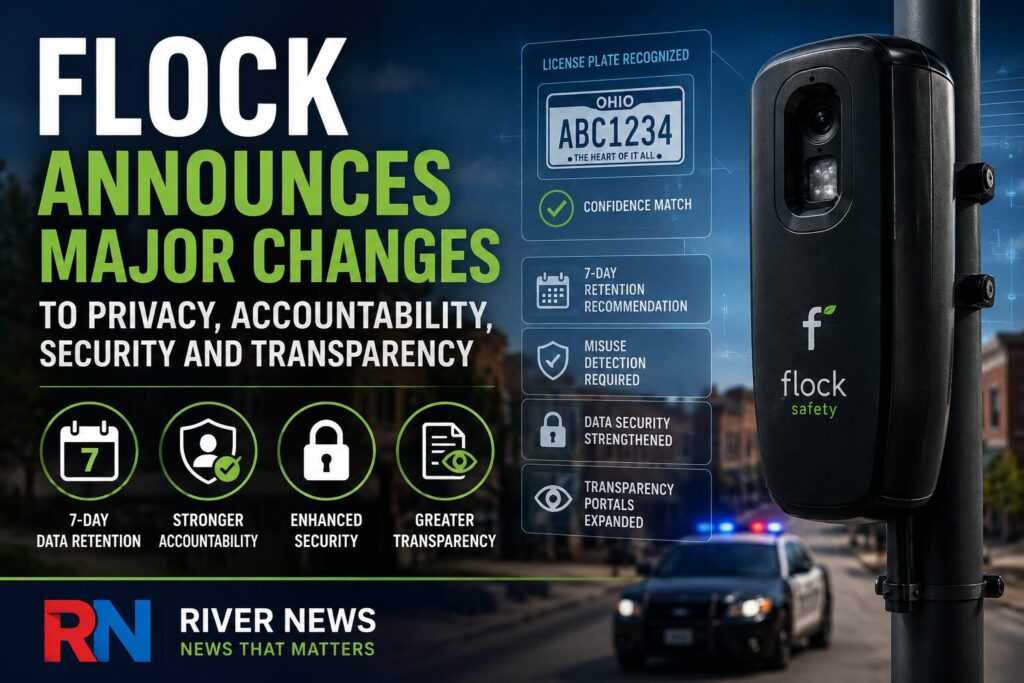
Flock Safety is introducing a series of changes to its automated license plate reader system, including a new seven-day default data-retention period, mandatory misuse detection for law enforcement customers and additional controls over how agencies share and search data.
The changes were announced Aug. 13 by Flock founder and CEO Garrett Langley as updates focused on privacy, accountability, security and transparency. River News reviewed Flock’s announcement directly for the details below.
One of the biggest changes involves how long license plate reader data is stored. Flock said it is changing its recommended and default retention period from 30 days to seven days.
However, that does not mean every existing Flock camera will automatically switch to seven days. Existing customers will retain their current retention periods, and communities will continue to determine how long their data is kept under applicable policies and laws.
Flock also plans to introduce an “Evidence Mode,” allowing investigators to preserve specific ALPR records connected to an active investigation beyond the normal retention period. According to Flock, customers adopting the seven-day recommendation will receive the feature at no additional cost.
Another new feature will allow agencies to limit shared-camera searches based on the type of offense. Flock said a community could, for example, permit another agency to search its cameras for stolen vehicles, missing persons or violent crimes while prohibiting searches for other purposes.
The company is also expanding safeguards intended to identify potential misuse by law enforcement users. Flock’s “Audit Assistance” system, which looks for abnormal activity and flags it for administrator review, will become mandatory for all law enforcement customers by the end of 2026.
Flock said it will also introduce automatic lockouts when user activity meets defined criteria for abnormal behavior. Access would be suspended while an administrator reviews the activity.
Case codes will also become mandatory for law enforcement searches by the end of the year. Emergency searches may bypass that requirement, but Flock says those searches will be flagged for administrator review.
Security changes include mandatory multi-factor authentication for users logging into Flock. The company also retained cybersecurity firm Bishop Fox to independently review its products and says it plans to publish a summary of the firm’s findings and Flock’s remediation work in September.
Flock is additionally launching a Coordinated Vulnerability Disclosure program intended to provide security researchers with a formal process for reporting vulnerabilities.
The company reiterated that customers own the data collected by their cameras and determine who may access it and with whom it is shared. Flock said it plans to publish a plain-language explanation of its contractual terms to make those responsibilities clearer.
Flock also addressed the accuracy of ALPR alerts, emphasizing that an alert is intended to serve as an investigative lead rather than a determination that a vehicle or driver is involved in a crime. The company says officers are expected to independently verify information before taking action.
Flock reported that more than 1,500 agencies have made a public Transparency Portal available. Those portals can provide information about an agency’s retention policy, sharing relationships, search activity and other policies.
The announcement represents changes to Flock’s technology and company policies, but implementation will vary. Some measures are still being developed or rolled out, existing agencies are not automatically being moved to seven-day retention, and local policies will continue to influence how individual Flock systems are operated.
Read Flock Safety’s full announcement: